
Nobody is going to call you
On the harm that lands long after you’ve left, and why the people responsible for it are almost never the ones who find out.
I’ve spent close to twenty years working in international schools, in four different countries. Somewhere in each of them is data I touched and then left behind. A student information system I set up or managed. A shared drive I reorganised. A vendor contract I signed. None of it is mine to answer for now. Most of it I couldn’t reach if I tried. And if something I configured a decade ago goes wrong next year, I won’t hear about it. I won’t be there. I left a long time ago.
That’s the part of student data nobody quite reckons with. The harm and the person who could have prevented it almost never sit in the same place at the same time.
Almost everything we treat as common sense about risk, we learned the same way. The consequence came back to us. Miss one flight because you left too late, and you never leave too late again. Book an Airbnb for the wrong date and you’ll always check three times before confirming and paying. Well, almost every time. The carefulness is just memory of the last time it cost you something. Data protection has one kind of harm that works that way, and one that doesn’t.
Mishandle my own bank details and I find out fast. An alert fires within the hour, someone calls, and the problem has my name on it. I’ve written before about why that makes banking feel almost sacred and everything else feel optional and inconvenient. We protect what we can imagine losing, and banking is easy to imagine, because the cost lands the same week and it lands on us.
Mishandle a child’s data and nobody calls. Not you, not them, not anyone. Nothing comes back. There’s no fraud team for a child’s counselling note. The harm, if it comes, comes years later, to a person who is no longer a child, somewhere you’ll never see. They won’t know it connects to you. You won’t know you did anything. And by then you may be three schools and two countries away. The child has moved on into adulthood. You’ve moved on into another job. The data stayed exactly where it was, and it outlived both of you being in the room.
That’s not a moral failing on anyone’s part. It’s that the lesson never arrives. The carefulness we’d build from getting it wrong can’t form here, because the person who could prevent it is never the person who pays for it.
The child can’t stand in for themselves either. When my own details leaked, I could act, because I understood what was at stake. A child can’t. They don’t know it’s happening, couldn’t consent if you explained it, and by the time they’re old enough to care, the data left the building years ago, in the keeping of people who’ve since left too.
Here’s the part that should unsettle anyone who’s signed an edtech contract lately.
We’ve all been told there’s a backstop. If it goes wrong, delete the account. Request erasure. The right to be forgotten. Nearly every data protection law has some version of it written in, and it lets everyone relax and enjoy the new product and the whiz-bang features, because even if data ends up where it shouldn’t, in the end it can be pulled back.
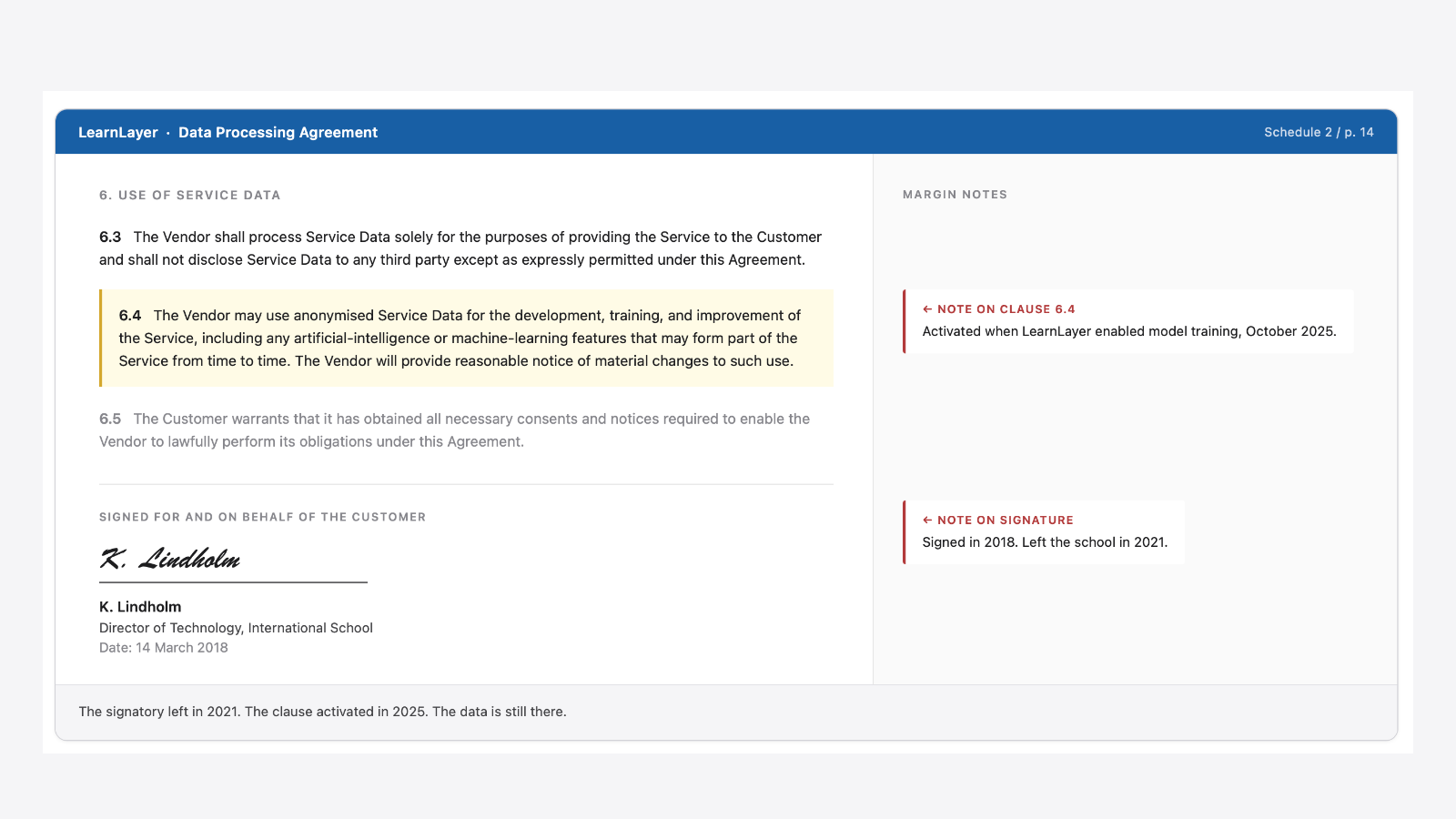
What we don’t realise is that backstop stops working the moment the data trains a model.
When a system learns from a piece of data, the data doesn’t sit in a row you can find and delete. It dissolves into the model’s parameters, in no single place. You can delete the original file. What the model learned from it stays. The UK’s data regulator has said plainly in its guidance on AI: erasing personal data from a trained model may not be possible without retraining the model from scratch, or deleting it altogether. As things stand in 2026, once a child’s data is in, it stays in.
Now look at where student data is going. Every edtech tool is racing to add AI. The writing platform with the assistant built in. The reading app that listens to a child sound out words. The tutoring system that adapts to one student across the year. The vendor turns AI on. In my experience the default is always on. Almost nobody asks the question a steward of children’s data should be asking. Which student data feeds the model and can it ever come out? The answer to the second half is no, or not yet, or maybe not ever.
No breach anywhere in that. Nobody broke in. The data did exactly what the contract allowed, and the right you had to undo it stopped working the moment the model learned.
There’s a quieter version of the same blindness. The most sensitive thing a school holds is usually the thing it wrote down to keep a child safe. The note about which parent must never get the pickup schedule. The reason an address carries a flag. Inside your walls, that record only ever protects. The same record, loose, is a map straight to the thing the child needed protecting from. The protective record and the dangerous record are the same record. That’s why it’s so hard to picture. You’ve only ever watched this data help.
Here’s where I keep landing. Everything else you guard children against eventually tells you whether you got it right. The near-miss. The incident at the school down the road. This one won’t. You can do this work carefully for thirty years and never once be told it mattered. No grown student will write to thank you, because they’ll never know there was anything to thank you for. The reward for getting it right is the same silence as getting it wrong.
That’s what makes stewardship harder than compliance. Compliance can be checked. You either followed the rule or you didn’t, and someone can tell you which. Stewardship can’t be checked by anyone, least of all you. You make a judgement on behalf of someone you’ll never meet as the adult they’ll become, and you never find out whether you got it right.
Anyone can be careful about the mistakes that find their way back to them. The job is being careful about the one that never will. The mistake that lands on someone else, long after you’ve gone, somewhere you’ll never see.